Totalling vs Totaling: Which Spelling Is Correct in the US and UK?
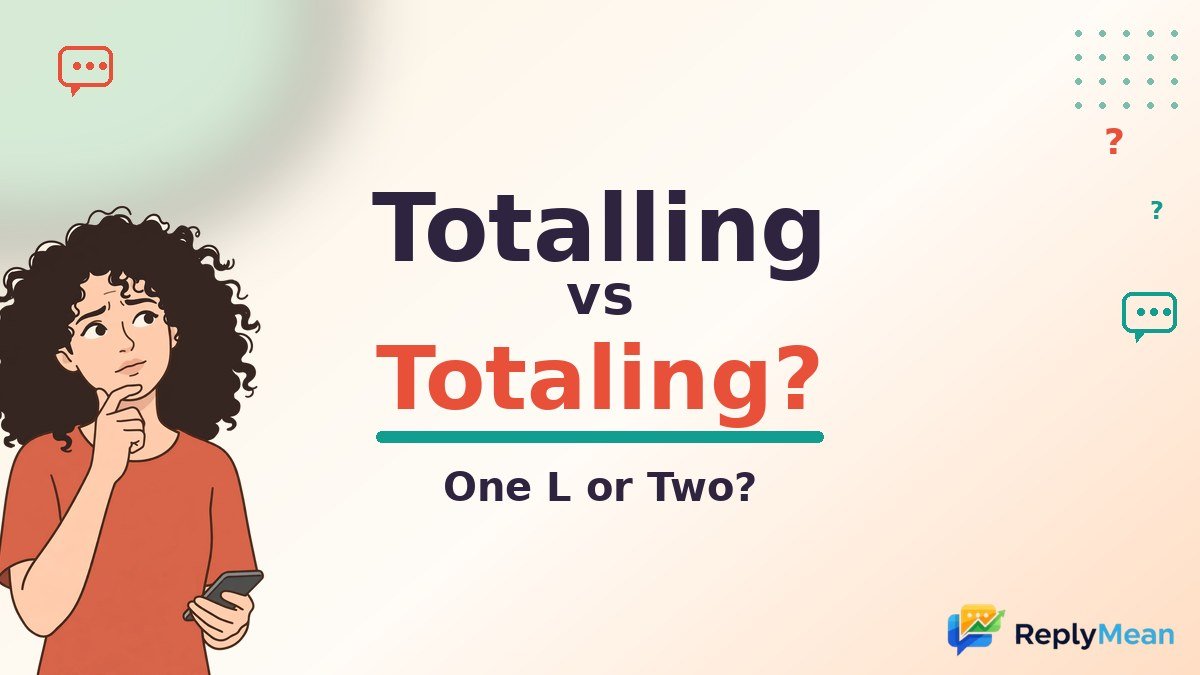
If you have ever paused over a spreadsheet, one finger hovering above the keyboard, unsure whether to type totalling or totaling, you are not alone. The question of totalling or totaling comes up for students, accountants, editors and anyone who writes for readers on both sides of the Atlantic, and it has a cleaner answer than most spelling puzzles.
Both spellings are correct, and neither one changes what the word means. What changes is where your writing belongs: one form is at home in British English, the other in American English, and mixing the two inside a single document is the only real mistake here.
This guide settles the choice properly. You will get the short answer first, then the full family of forms — totaled, totalled, totals and the rest — the actual spelling rule that produces the difference, the words that behave in exactly the same way, and a short checklist and quiz so the right form becomes automatic.
What do “Totalling” and “Totaling” Mean?
Quick answer: Both spellings are correct — totalling with a double L is the British English form, and totaling with a single L is the American English form. Pick the one that matches your audience and use it consistently, because the meaning is identical either way.
Totalling and totaling are forms of the verb total, which means to add a set of numbers together, or to reach a particular amount when everything is added up.
When a manager works through a pile of invoices and adds them, she is totalling them in London and totaling them in New York. The action, the numbers and the result are the same; only the spelling of the verb changes.
A few ordinary examples show the word at work:
- British: The shopkeeper is totalling the day’s takings before he locks up.
- American: The shopkeeper is totaling the day’s takings before he locks up.
- British: Her donations are totalling more than she expected this year.
- American: The repairs are totaling more than the car is worth.
Notice that the word can do two slightly different jobs. In the first pair of sentences it means actively adding numbers together. In the second pair it means amounting to a figure — nothing is being added by hand, the numbers simply come to that much. Both jobs take the same spelling choice.
As a Noun
Strictly speaking, totalling and totaling are not nouns themselves — the noun in this family is total, as in “the total came to £240.” What totalling and totaling can do is the work of a noun inside a sentence, because the -ing form of a verb (the gerund) can stand where a noun stands:
- British: The totalling of the votes took until midnight.
- American: Careful totaling of the stock revealed two missing boxes.
In sentences like these, the -ing form names the activity of adding up. That is the honest version of the “noun” use: the word behaves like a noun, but it still describes the action of adding, never the final sum itself. If you mean the final sum, the word you want is total.
As an Adjective
The -ing form can also sit in front of a noun and describe it, which is its adjective-like job:
- British: A totalling error in the spreadsheet threw the whole budget out.
- American: Her totaling speed impressed the rest of the accounts team.
Here totalling and totaling describe the error and the speed rather than naming an action in progress. This use is less common than the plain verb use, but it is perfectly correct in both varieties — as long as the number of Ls matches the variety you are writing in.
“Totalling or Totaling”: What’s the Difference?
The difference is exactly one letter, and it is a regional signal rather than a difference in meaning, grammar or pronunciation. Totalling with two Ls is the standard form in British English and in the varieties that follow British conventions, such as Australian and most Canadian writing. Totaling with one L is the standard form in American English.
| Form | British English | American English |
|---|---|---|
| -ing form | totalling | totaling |
| Past form | totalled | totaled |
| Base verb | total | total |
What the Dictionaries Record
Dictionaries record the split plainly. The Cambridge Dictionary’s entry for the verb shows the British example “We totalled (up) the money we had each earned,” while its American side gives the inflections as “-l- | -ll-“, and Wiktionary lists the forms as “present participle (US) totaling or (UK) totalling, simple past and past participle (US) totaled or (UK) totalled.”
Merriam-Webster’s American examples use the single-L forms throughout — “He carefully totaled the bill” and “totaling $86,107.”
So the difference is not about one form being right and the other wrong. It is about which dictionary your reader’s variety follows. Choose the form for your audience, and the question answers itself.
Totalled, Totaled and Totals: The Whole Family of Forms
Writers meet the whole family in real work, not just the -ing form, and every member follows the same regional split:
| Verb form | British English | American English |
|---|---|---|
| Present (I/you/we/they) | total | total |
| Third person present | totals | totals |
| Past simple | totalled | totaled |
| Past participle | totalled | totaled |
| -ing form | totalling | totaling |
- British: She totalled the column twice and got the same answer both times.
- American: He totaled the column twice and got the same answer both times.
- British: The three invoices total £1,150.
- American: His expenses total $1,150 this quarter.
Two Neighbours That Cause Side Confusion
Two neighbours of this family cause side confusion, so it is worth clearing them up here. Totally is an adverb meaning completely, and it is spelled with two Ls in every variety of English — totally is never “totaly.”
And a total can also be damaged beyond repair in informal American usage — “she totaled the car” — which is the same single-L past form doing a different job.
Neither of these changes the rule above: before -ed and -ing, British English doubles the L and American English does not.
Why Is There Confusion Between “Totalling” and “Totaling”?
The confusion has three honest causes. First, the two forms look almost identical, so a reader who learned one variety barely notices the other — until an editor, a teacher or a spell checker flags it.
Mixed Audiences and the Doubling Habit
Second, many writers work for mixed audiences now: a report written in London may be read in Chicago, and the writer genuinely does not know which convention to follow.
Third, English really does double final consonants in many words — stopped, planned, controlled — so a single L in totaling can feel like something is missing, while the double L in totalling can feel like a typo to American eyes.
The Stress Rule Nobody Teaches in Full
There is also a subtler cause. The stress rule that governs doubling in American English is rarely taught in full, so writers are left guessing from half-remembered patterns.
That rule is explained properly further down, in the section on why American English keeps one L — once you have it, this word and a whole class of similar words stop being guesswork.
A Simple Trick to Get Rid of Confusion
Decide your variety before you write the first sentence, not when you reach the difficult word. If the document is British — a UK school essay, a London firm’s report, a letter to a British client — write totalling and totalled throughout.
If it is American — a US memo, an American website, homework for a US school — write totaling and totaled throughout.
Hold the Line With Your Tools
Then use your tools to hold the line. Set your spell checker’s language to English (UK) or English (US) to match, because a checker set to the wrong variety will “correct” the right form into the wrong one.
If you inherit a document that mixes both forms, a quick find-and-replace pass for “totalling” and “totaling” will show you every instance in seconds, and you can bring them all into line with the variety you chose.
Synonyms of “Totalling” or “Totaling”
Sometimes the cleanest way out of a spelling doubt is a different word, and English offers plenty for the act of adding up:
- Adding up — the everyday phrasal verb: “She is adding up the week’s expenses.”
- Summing — shorter and slightly more formal: “He is summing the scores for each round.”
- Tallying — counting items off against a list: “They are tallying the votes as they come in.”
- Calculating — working a figure out, often with more steps than simple addition: “The software is calculating the tax due.”
- Counting up — informal and friendly: “We are counting up the coins from the collection tin.”
Each of these is spelled the same way in British and American English, so they are safe substitutes in a document for a mixed audience. Just note the small differences in flavour: tallying suggests matching against a record, and calculating suggests a process more involved than a straight sum.
Using “Totalling” and “Totaling” in Sentences
Seeing the forms inside full, natural sentences is what fixes them in memory. Here is a set for each variety, in the kinds of writing where this word actually appears:
British English:
- The treasurer is totalling the raffle money in the back office.
- By Friday, the repairs were totalling nearly four thousand pounds.
- She sat totalling the scores while the judges compared their notes.
- The charity thanked donors whose gifts were totalling more every hour.
American English:
- The treasurer is totaling the raffle money in the back office.
- By Friday, the repairs were totaling nearly four thousand dollars.
- She sat totaling the scores while the judges compared their notes.
- The campaign thanked donors whose gifts were totaling more every hour.
Read the two sets side by side and one thing stands out: nothing else in the sentences needs to change. The verb keeps the same tense, the same meaning and the same sound.
Only the spelling of this one word reports which variety the document belongs to — which is exactly why editors treat consistency in it as a sign of care.

Origins of “Totalling” and “Totaling”
The word total itself is old. Merriam-Webster traces the adjective to the 14th century, from Anglo-French, from Medieval Latin totalis, from Latin totus, meaning whole or entire. The noun arrived in 1557 and the verb in 1716, so writers have been totalling — in one spelling or another — for about three centuries.
The split between the two spellings is much younger than the word. It belongs to the broader parting of British and American spelling conventions, in which American English, following the pattern of its early dictionaries, tended to keep single consonants where British English doubled them before -ed and -ing.
Total fell into the same class as travel, label and cancel: words ending in a single vowel plus L, where the two varieties settled on different habits. Neither form was invented for this word alone; each is simply the local application of a general spelling habit.
Regional Differences in Spelling
The regional map for this word is straightforward, but the details matter for anyone writing internationally:
- United Kingdom: totalling, totalled.
- United States: totaling, totaled.
- Australia and New Zealand: follow the British pattern — totalling, totalled.
- Canada: mostly follows the British pattern for this class of word — totalling, totalled — though American forms appear near the border and in US-facing publications.
- International organisations and global publishers: each follows its own house style; the UN and most British-based bodies use the double L, while US-based companies and journals use the single L.
The practical lesson is that “region” really means “the convention your publication follows,” not the passport of the writer. A British writer producing copy for an American magazine writes totaling, and an American writing for a British journal writes totalling. Match the house, and you match the region.
Why American English Keeps One L in Totaling
Here is the rule that actually explains the word. In American English, a final consonant is doubled before -ed or -ing only when the last syllable of the word carries the stress: begin becomes beginning, control becomes controlled and compelled, because the stress falls on the final syllable.
When the stress falls earlier, American English does not double: open becomes opening, visit becomes visiting — and total, stressed firmly on its first syllable (TO-tal), becomes totaling and totaled.
Where the Two Varieties Part Company
Final L is where the two varieties part company. British English doubles a final L before -ed and -ing whether or not that syllable is stressed, which is why British writers produce travelling, labelled, cancelled — and totalling.
American English treats L like every other consonant and applies the stress test, producing traveling, labeled, canceled — and totaling. So “total” is not an exception that breaks the American rule; it follows the American rule exactly.
It only looks like an exception if you expect the British habit to apply everywhere.
When Both Varieties Double the L
One warning against over-applying this: words stressed on the final syllable double the L in both varieties. Nobody writes “controled” or “compeled” — controlled and compelled keep two Ls in London and in New York alike. The stress test is the difference; the letter itself is not.
Words That Behave the Same Way: Travel, Label and Cancel
Total belongs to a recognisable family — verbs ending in a single vowel plus L, stressed on the first syllable. Learn the family once and you never have to look any of them up again:
| Verb | British -ing / past | American -ing / past |
|---|---|---|
| total | totalling / totalled | totaling / totaled |
| travel | travelling / travelled | traveling / traveled |
| label | labelling / labelled | labeling / labeled |
| cancel | cancelling / cancelled | canceling / canceled |
| model | modelling / modelled | modeling / modeled |
| equal | equalling / equalled | equaling / equaled |
- British: She is labelling the boxes before they go into storage.
- American: She is labeling the boxes before they go into storage.
- British: They are travelling to Manchester for the final.
- American: They are traveling to Denver for the final.
One honest footnote: you will occasionally see double-L forms in American writing and single-L forms in British writing, because individual style guides and personal habits vary, and some American publications accept “travelled” as a variant. That does not make the standard forms unclear — dictionaries give totaling for the US and totalling for the UK, and standard practice follows them.
Common Mistakes with “Totalling” and “Totaling”
Most errors with this word fall into five repeatable patterns:
- Mixing both forms in one document. Totalling in paragraph two and totaling in paragraph nine is the single most common fault, and it is the one readers actually notice.
- Letting the spell checker decide. A checker set to the wrong variety will happily “fix” every correct form into the wrong one, consistently and silently.
- Doubling where no variety doubles. “Tottaling” and “totalling” with a doubled T are simply misspellings; the base word is total, with one T.
- Applying the pattern to totally. Totally always has two Ls, in every variety — writers who have just learned the single-L American rule sometimes “correct” it to “totaly,” which is wrong everywhere.
- Guessing in the past tense. The same split applies to totalled/totaled, and writers who settle the -ing form often leave the past form inconsistent. Settle both at the same time.
None of these is a meaning error — every reader will understand you either way. They are polish errors, and polish is exactly what this word tests.
When to Prefer One Over the Other
Prefer totalling when your document follows British English: UK and Commonwealth audiences, British schools and universities, British publishers, and any house style built on British conventions. Prefer totaling when your document follows American English: US audiences, American schools and businesses, US publishers, and house styles built on American conventions, such as Associated Press or Chicago style.
If your audience is genuinely mixed and no house style applies, choose the variety used by the rest of your document. A page that writes “organised” and “favourite” should write totalling; a page that writes “organized” and “favorite” should write totaling.
The word should never be the only British — or the only American — spelling on the page. Consistency across the whole document is the preference that outranks all the others.

Impact on Professional Writing
Nobody loses a contract over one letter — but spelling consistency is one of the cheapest signals of care a document can send.
A finance report, an audit summary or a client proposal is, by its nature, a document full of totals; the verb that describes producing them appears again and again, and an inconsistency in it sits on the page next to the figures themselves.
A reader who spots totalling on page one and totaling on page four may not say anything, but the doubt it plants is about the numbers, not the spelling.
The Other Side of the Signal
The reverse is also true. A document that holds one form steadily, matches it to its audience, and keeps its totals, totalled amounts and summaries in the same variety reads as controlled and trustworthy.
For students the stakes are plainer: examinations and coursework marked under British conventions can treat totaling as a spelling error, and American markers can treat totalling the same way.
In professional writing, this word is a small, visible test of whether the writer chose a standard and kept it — and it is an easy test to pass.
Pronunciation Guide
The two spellings sound exactly alike, which is part of why the written choice confuses people: your ear cannot help you.
The verb total is pronounced TO-tal (/ˈtəʊ.təl/ in British English, /ˈtoʊ.t̬əl/ in American English), with the stress on the first syllable — the same stress pattern that drives the American spelling rule described above. Adding -ing gives TO-tal-ing in both varieties.
Spelling You Cannot Hear
Because the sound gives no clue, do not try to “hear” the double L. There is no extra L sound in totalling; the second L is a spelling convention, not a pronunciation.
If you are dictating or using speech-to-text, check which variety your software is set to afterwards, because it will choose for you — and it may not choose the variety you intended.
Related Words and Expressions
The family around this word is worth knowing as a set, because writers often need the noun and adjective forms in the same document:
- Total (noun) — the final amount: “The total is due on Friday.”
- Total (adjective) — complete or including everything: “a total failure,” “the total cost.”
- In total — the usual phrase for giving a combined figure: “We raised $4,200 in total.”
- Grand total — the final sum of several subtotals: “The grand total includes tax and delivery.”
- Subtotal — a partial sum, before tax or further additions: “The subtotal comes to £86.50.”
- Tally — a running count, and the verb for keeping one: “Keep a tally of the entries as they arrive.”
- Sum up / add up — the everyday phrasal alternatives, spelled identically in both varieties.
Note that none of these neighbours has a spelling split. Subtotal, grand total and tally are written the same way everywhere; only the -ed and -ing forms of the verb total change with the variety.
Confusion in Digital Writing
Digital writing makes this particular mix-up more likely, for reasons that have little to do with the writer’s knowledge. Autocorrect and predictive text are trained and configured per device, so the same person can produce totalling on a phone set to British English and totaling on a work laptop set to American English without noticing either.
Copy-pasting between documents carries one variety into another. Templates, AI writing tools and grammar checkers each apply their own default variety, often silently.
Spreadsheets and the Simple Defence
Spreadsheets add their own twist: formulas and exported reports generate labels and summaries automatically, and a document assembled from several tools can end up with both spellings before a human writes a word.
The defence is boring and effective — set every tool you control to one variety, and run one find search for both spellings before anything is sent, published or submitted. Thirty seconds of searching finds what thirty minutes of careful writing can miss.
Grammar Rules for Totalling vs. Totaling
The rules, gathered in one place:
- Totalling and totaling are the -ing form (present participle and gerund) of the verb total, meaning to add up or to amount to.
- British English doubles the final L before -ed and -ing regardless of stress: totalling, totalled.
- American English doubles a final consonant only when the final syllable is stressed; total is stressed on the first syllable, so it keeps one L: totaling, totaled.
- The same American stress rule doubles the L in final-syllable-stressed words in both varieties: controlled, compelled, patrolled.
- The base word and its other forms — total, totals, totally — are spelled the same in both varieties, and totally always has two Ls.
- Whichever variety you choose, apply it to every form in the document.
That is the complete grammar of the question. There is no meaning rule, no formality rule and no exception for formal documents: variety plus consistency is the whole answer.
Quiz: Can You Spot the Correct Usage?
Try these with the variety named in each question — that is what makes them answerable, and it is how the choice works in real writing too.
- (British English) “The clerk is ___ the day’s receipts.” — totalling or totaling?
- (American English) “The clerk is ___ the day’s receipts.” — totalling or totaling?
- (British English) “She ___ the scores before announcing the winner.” — totalled or totaled?
- (American English) “His expenses are ___ more than he earns.” — totalling or totaling?
- (Either variety) “It was a ___ disaster.” — totally or totaly?
Answer key: 1 — totalling. 2 — totaling. 3 — totalled. 4 — totaling. 5 — totally (two Ls in every variety).
If you missed any, the pattern to carry away is the stress rule: TO-tal is stressed on the first syllable, American English therefore keeps one L, and British English doubles final L as a matter of course.
A 10-Second Checklist Before You Send, Submit or Publish
Run this before any document containing this word leaves your hands:
- Which variety is this document — British or American? Say it out loud.
- Totalling/totaled forms: does every -ing and past form match that variety?
- Search the document for both spellings. If both appear, one of them is wrong here.
- Is your spell checker set to the same variety as the document?
- Check the neighbours: totally with two Ls, total and totals unchanged.
- If the document uses other variety markers (organised/organized, favourite/favorite), does this word agree with them?
Six checks, ten seconds, and the question never reaches your reader.
Frequently Asked Questions
Is totalling or totaling correct? Both are correct. Totalling is the British English spelling and totaling is the American English spelling; the right choice is the one that matches the variety of your document.
Is it totalled or totaled in the past tense? The same split applies: totalled in British English, totaled in American English. Whichever you choose, use the matching -ing form as well.
Why does American English use only one L in totaling? Because total is stressed on its first syllable (TO-tal), and American English doubles a final consonant before -ed and -ing only when the final syllable is stressed. British English doubles a final L regardless of stress, giving totalling.
Is “totally” spelled with one L or two? Two, always, in every variety of English. Totally is an adverb meaning completely, and it never follows the totaling rule.
What about Canadian and Australian English? Australian English follows the British forms — totalling, totalled. Canadian English mostly does the same for this class of word, though American forms appear in US-facing Canadian publications.
Will using the wrong form change the meaning? No. The meaning, pronunciation and grammar are identical. The only risk is looking inconsistent or mismatched to your audience, which is why consistency matters more than the choice itself.
Conclusion
Totalling or totaling is a one-letter question with a complete answer: both forms are correct, the double L belongs to British English, the single L to American English, and the stress on the first syllable of TO-tal is why American spelling keeps the L single.
Once you know the rule, the whole family — totalled and totaled, travelling, labelled and cancelled — falls into place with it.
So choose your variety, set your tools to match, and hold the form steady from the first paragraph to the last. For the wider picture, Cambridge’s guide to British and American spelling is the reliable place to read next.