Cocoon vs Cacoon: Which Spelling Is Correct?
It happens mid-sentence. You are writing about a moth, a science lesson or a weekend spent hiding from the world, and your fingers produce a word that looks almost right: cacoon. The hesitation that follows — cocoon vs cacoon, and which one the dictionary backs — is a spelling stall, because the word gives your ear nothing to go on.
The right verdict is cocoon — but two claims commonly printed beside it are wrong. Butterflies do not stay in a cocoon before they fly: a butterfly’s pupa is a chrysalis, and the silk cocoon belongs chiefly to moth caterpillars. And cacoon is not missing from the dictionary: Merriam-Webster has listed it since 1797 — as a tropical American plant.
What follows puts the verdict up front, makes both corrections openly with the dictionary entries named, and gives fresh examples throughout — plus the whole word family (cocoons, cocooned, cocooning) and the neighbouring science words, pupa and chrysalis. A ten-second checklist near the end settles the spelling by meaning, since sound cannot.
The Short Answer: Cocoon — Every Time the Insect Is Meant
Quick answer: in the cocoon vs cacoon question there is only one spelling for the insect’s silk case, and it is cocoon — c-o-c-o-o-n. Write cocoon for the case a moth caterpillar spins, for the verb (to cocoon yourself away from the world), and for the metaphor of a safe, quiet place. Cacoon is not a variant of it. The string c-a-c-o-o-n exists in English as two unrelated things — a brand name for hanging chairs, and a dictionary-listed name for a tropical plant — neither of which will ever be what your sentence means.
Why the wrong version feels right is worth understanding, because the feeling will come back. Cocoon is pronounced kuh-KOON — Cambridge gives /kəˈkuːn/ — so the stress lands on the second syllable and the first shrinks to a schwa, the vaguest sound in English, the one spelled “a” in “about” and “o” in “today”. An ear that hears “kuh” and reaches for “a” is doing something reasonable. It is also doing something the brand name then confirms, which is how a guess hardens into a habit.
First impressions are where this error does its damage: a misspelt word in an opening line quietly taxes everything written after it. It is the same reason the first line of an email deserves the care our guide to other ways to say i am writing to inform you gives it — readers judge a message by its surface before they reach its substance. “Cacoon” in a science essay or a product description announces, fairly or not, that nobody checked.
Why is There Confusion?
Three forces push writers toward the wrong spelling, and none of them is carelessness. The first is sound: the word opens with a schwa, and “kuh” carries no instruction about which vowel letter to write. The second is shape: the two spellings differ by exactly one letter — the second — so a page containing “cacoon” does not look wrong at a glance. The third is exposure: the hanging-chair brand has put the a-version on retail sites, instruction manuals and garden-centre shelves, so the a-version starts to feel like the normal one. Familiarity impersonates correctness.
What is a “Cacoon”?
Start with what it is not: it is not a spelling of the insect case, in any dictionary, at any level of formality. If a sentence is about a caterpillar, a pupa or a quiet retreat, “cacoon” in it is simply a misspelling — the a-version of the word does not exist in that sense.
But the letters c-a-c-o-o-n are not nothing. Merriam-Webster lists cacoon as a real English word: “a tropical American plant (Fevillea cordifolia) of the family Cucurbitaceae with seeds which have cathartic qualities” — in the language since 1797, and perhaps borrowed from a Yoruba name for a woody vine. And in shops, Cacoon, capitalised, is a brand of hanging tent-chairs, named for the pod shape they imitate. So “cacoon” has two legitimate lives, one botanical and one commercial. Neither of them is yours when you are writing about insects.
The tangle trips up even careful explanations of this word. You will see it claimed that “you might spot the word cocoon on a label for a trendy hanging chair” — the label word is the brand’s, cacoon — and the sentence “I ordered a new cocoon for my backyard” marked wrong as brand misuse, although that sentence spells the word correctly.
What is a “Cocoon”?
Cambridge Dictionary defines the noun as “the covering made of soft, smooth threads that surrounds and protects particular insects during the pupa stage as they develop into adult form”. The spinners are chiefly moth caterpillars — the silkworm is the famous one — and some spiders spin a cocoon around an egg sac.
Cambridge gives the word a second life as well: a cocoon is also “a safe, quiet place”, and as a verb, to protect someone or something from pain or an unpleasant situation. Merriam-Webster dates the noun in English to 1699 and the verb to 1880, which makes cocoon the settled, centuries-old citizen of the pair.
“Cacoon” vs “Cocoon”: The Differences
| Cocoon | Cacoon | |
|---|---|---|
| Spelling | c-o-c-o-o-n | c-a-c-o-o-n |
| Status | The standard word | A misspelling in this sense; a real word in another |
| Means | The silk case of a pupa; a safe, quiet place; (verb) to wrap and protect | A tropical American plant (Merriam-Webster); a hanging-chair brand |
| Use it when | Always — for insects, retreats and metaphors | Only naming the brand, or writing botany |
One letter — the second — carries the whole difference, which is why the mistake is so easy to make and so easy to miss in proofreading.
Spelling Differences Explained
Put the two side by side and the difference is a single letter deep: cocoon, cacoon. Everything after the second letter is identical, including the double o in the middle and the -coon tail the word shares with “raccoon” — one reason the back half never causes trouble. All the doubt concentrates in the first syllable, and the first syllable is the one the pronunciation leaves blank: kuh-. Writers do not misspell the part they can hear. They misspell the part they cannot, and they fill the blank with the commonest vowel letter in English: a.
Calling it a phonetic misspelling is accurate but incomplete. The sound does not merely mislead; it stays silent, and a letter the ear cannot recover has to be carried by meaning or by memory instead.
Meaning of “Cacoon” and “Cocoon”
Cocoon carries three connected meanings. The literal one is the silk case. The extended one is any snug, protective wrapping — a cocoon of blankets, of silence, of wealth. The verbal one turns the image into an action: to cocoon is to wrap up and shut the world out for a while. Cacoon, in a sentence about any of these, carries no meaning at all: a reader either corrects it silently or trips over it.
One correction belongs here, because the error is widespread and often ticked as model usage: “Butterflies stay in a cocoon before they fly.” They do not. A butterfly’s pupa is called a chrysalis — a hard, smooth case formed from the caterpillar’s own body — and no silk is spun around it. The silk cocoon is spun chiefly by moth caterpillars, around the pupa resting inside. The science-words section below lays the three terms side by side.
The Whole Family: Cocoons, Cocooned and Cocooning
Settle the base word and the whole family follows, because every relative is built from the same six letters — which is why the cocoon vs cacoon decision is worth making once, properly. The plural adds a plain s: cocoons. The verb runs cocoon, cocoons, cocooned, cocooning, with no letter doubled or dropped anywhere.
Merriam-Webster’s own example sentences show the family at work in modern prose: “Americans are spending more time cocooning at home in recent years”, and skiers “cocooned in puffy down parkas”. The staying-in sense — retreating into your home and shutting the world out — is now the verb’s most familiar everyday use, and it is spelled with the same co- opening as the insect case.
Usage: When to Use Each Word
Use cocoon in every sentence about the natural world — the moth’s cocoon, a cocoon of silk — in school and scientific writing without exception, in the metaphorical senses (a cocoon of calm, cocooned from criticism), and as a verb. No register — formal, casual or poetic — accepts cacoon as a spelling of this word.
Reserve cacoon for the two jobs it actually has: as a proper name, capitalised, when the product itself is the subject (“the Cacoon hangs from a single hook”), and in botanical writing about the plant. If neither a shop nor a herbarium is involved, the a-version is wrong.
Examples of “Cacoon” and “Cocoon” in Context
Fresh examples, grouped by the job the word is doing. Every cocoon sentence below is safe to copy; the two cacoon sentences at the end are the only patterns in which that spelling belongs.
In science writing:
- Over two days the caterpillar covered itself completely, and the cocoon hung from the twig like a small parcel.
- The class kept the cocoons in a ventilated box and noted the morning the first moth appeared.
As a metaphor:
- After the move, she lived for a month in a cocoon of takeaway menus and unopened boxes.
As a verb:
- They cocooned the seedlings in fleece against the late frost.
The only correct cacoon sentences:
- The Cacoon in the garden seats two, provided neither of you minds swinging.
- In the herbarium’s catalogue, cacoon is listed under its Latin name, Fevillea cordifolia.
Origins of “Cacoon” and “Cocoon”
Cocoon has a documented journey. Merriam-Webster traces it from the French cocon, from the Occitan coucoun, from coco — the Occitan word for “shell” — probably reaching back through the Latin coccum to the Greek kokkos, a berry. English took the word up in 1699 for the insect’s version of a casing; the verb followed in 1880. The journey is often shortened to “French cocon, meaning egg case”, which keeps the French stop and drops the shell the word grew from — a pity, because the shell is the best memory hook the word offers, as the next section shows.
Cacoon’s origin is a separate story, which is the point. Merriam-Webster gives its first known use as 1797 and suggests it was “perhaps borrowed” from Yoruba kàkàùn selà, a name for a woody vine. Two words, two continents, two histories: they were never variants of each other. They are strangers that happen to differ by one letter.
How to Remember the Correct Spelling of “Cocoon”
Use the word’s own history as the hook. Its ancestor coco meant “shell”, and the modern word still opens with those four letters: coco — a word you can already spell — plus on. Picture the shell first and the spelling assembles itself: coco + on, a case switched on around the pupa. If a draft of yours opens “ca-“, the shell has cracked: no form of this word, in three centuries of English, has ever begun with one.
The usual memory hooks offer a “cozy coat” and two watching eyes in the double o. Both are harmless; neither explains why the second letter is o rather than a, which is the only thing anyone actually forgets. The shell does: the o was in the word because the shell word carried it first.
Are People Really Searching for “Cacoon”?
You will find numbers attached to this question — “thousands of people search for cacoon online each month” — offered without a source, followed by the claim that people “overwhelmingly” search for cocoon instead, also without one. Treat both as decoration. What can be said without inventing figures is plainer and more useful: the misspelling is common enough to sustain product listings and forum threads, and the stall is real even if its size is not something anyone can honestly give you. Type “cacoon” into a search engine and it answers with cocoon results.
Why “Cacoon” Isn’t in the Dictionary
This section’s heading states the standard claim about cacoon, and the claim is wrong — which matters, because it is the load-bearing fact behind most advice on this pair. Open Merriam-Webster at cacoon and the word is there: a tropical American plant, Fevillea cordifolia, in the language since 1797.
What is true is narrower, and it is enough: cacoon is not in any dictionary as a spelling of cocoon. Dictionaries record words in their established senses. The plant sense has two centuries of botanical use behind it; the insect sense of “cacoon” has none — it appears only as an error and as a brand’s chosen name, and neither errors nor trademarks make a standard spelling. So the honest version of this heading would read: cacoon isn’t in the dictionary as this word. The verdict itself — never write cacoon for the insect case — survives the correction intact. Its evidence just needed to be the real evidence.
Common Typos Like “Cacoon” That Confuse Writers
Cacoon belongs to the family of errors that survive spellcheckers, and it is worth seeing why. A spellchecker works word by word: it asks whether “cacoon” is an English word, and — because of a tropical plant most of us will never meet — the answer comes back yes. The same trap catches “form” for “from” and “quiet” for “quite”: real words, wrong sentences. The usual typo lists instead recycle the standard trio — seperate, definately, acommodate — which any spellchecker flags on sight and which teach nothing about this pair.
The errors that actually gather around this word are its own: the vowel swap (cacoon); the doubled-letter guesses (coccoon, coccoon) from writers who know something in it doubles and guess the wrong letter; and cocon, which is a real word but the French one. Every one of them is a one-letter event. That is this pair’s whole difficulty, and its whole comfort: there is only one letter to get right.
Cocoon, Chrysalis and Pupa: The Three Words Science Keeps Apart
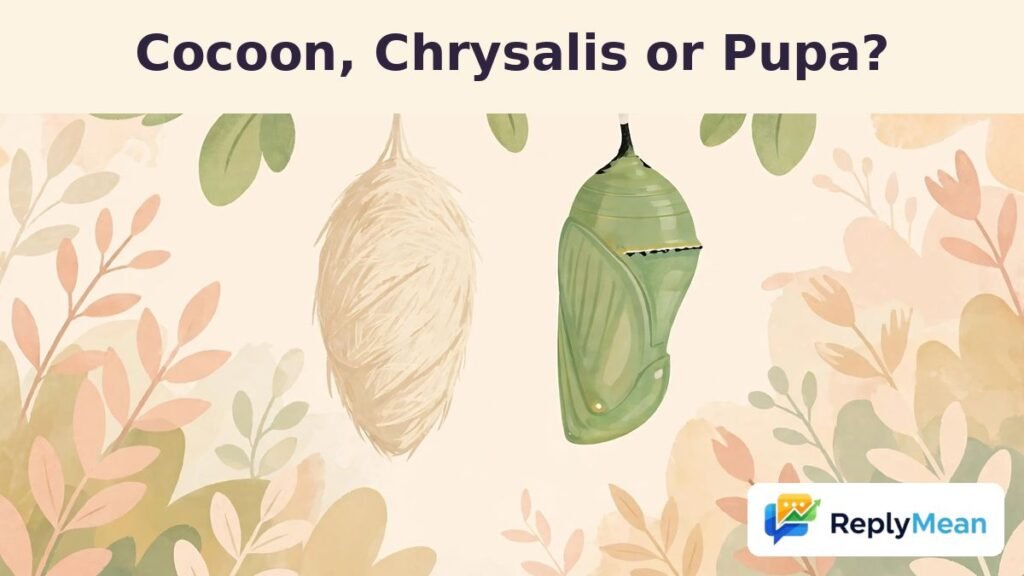
Half the trouble around this spelling is really trouble about the thing itself, so here are the three words pinned down. Pupa is the stage: the resting, transforming phase between larva and adult — every moth and butterfly passes through a pupa, whatever it is wrapped in. Chrysalis is the name for a butterfly’s pupa and its smooth, hard case: the caterpillar sheds its skin, the pupa itself is the case, and no silk is spun around it. Cocoon is a wrapping, not a stage: the silk case a larva — chiefly a moth caterpillar — spins around itself before pupating, so the pupa rests inside it.
The one-line test: if silk was spun, it is a cocoon; if it is a butterfly, it is a chrysalis; if you mean the life stage itself, the word is pupa. The commonly ticked example — “Butterflies stay in a cocoon before they fly” — fails all three at once, which is why it needs correcting wherever it appears.
Pronunciation Guide: Saying “Cocoon” Right
Cambridge gives cocoon as /kəˈkuːn/ — kuh-KOON — with the stress on the second syllable and the first syllable reduced to the schwa, the same sound that opens “about” and closes “sofa”. It rhymes with balloon and monsoon.
The common promise misleads: “if you say it right, chances are you’ll spell it right too — because the correct pronunciation points you straight to the correct spelling”. It points nowhere of the kind. Said perfectly, the first syllable is “kuh”, and “kuh” is precisely the sound that sends writers to “ca-“. Pronunciation is the cause of this error, not its cure; the cure is the shell in the word’s history and the meaning-check in the checklist below.
Using “Cocoon” in Metaphors and Everyday Language
Cambridge’s second sense — “a safe, quiet place” — is the one most adults meet most often. The metaphor keeps the insect’s three ingredients: enclosure, warmth, and a change happening out of sight. It can comfort — a cocoon of blankets on a sick day — or accuse: a cocoon of privilege, officials cocooned from the consequences of their own decisions.
- The old house became her cocoon: thick walls, low lamps, and no opinions before coffee.
The metaphor deserves more than two stock examples and a quick move on, because it carries the word’s everyday workload: for most adult writers the retreat is the sense reached for first, and the silk case is the picture that powers it.
Before You Write the Word: A 10-Second Check
Four questions, in order, the moment the hesitation starts:
- Is it the insect case, the retreat or the verb? Then it is cocoon — no exceptions, no registers.
- Does it open “co-“? The word begins with the old shell word, coco. If your draft reads “ca-“, the second letter is the error — and it is almost always the only one.
- Is a shop or a plant genuinely the subject? Only then can cacoon stand: capitalised for the brand, in botanical company for the plant.
- Did the spellchecker pass it? That proves nothing here: cacoon is a real word, so software waves it through. Read for meaning, not for red lines.
Frequently Asked Questions
In the cocoon vs cacoon question, which spelling is correct for the insect case?
Cocoon — always. It is the only spelling any dictionary records for the silk case, the safe place or the verb, and it has been the standard form since the noun entered English in 1699.
So is cacoon a real word or not?
Both, about different things. As a spelling of cocoon, cacoon is an error. As a word, genuine: Merriam-Webster lists it as a tropical American plant, in English since 1797, and a hanging-chair company uses it as a brand — never as the insect word.
Do butterflies come out of a cocoon?
No. A butterfly’s pupa is a chrysalis — a hard case formed from the caterpillar’s own body, with no silk spun around it. Cocoons are spun, chiefly by moth caterpillars, around the pupa. Any page that puts butterflies in cocoons is teaching a science error.
What are the plural and the verb forms?
Cocoons, with a plain s. The verb runs cocoon, cocoons, cocooned, cocooning: the endings attach without doubling or dropping anything, because the word ends in n. “Cocooning” at home — retreating and staying in — is the family’s most familiar modern member.
Why doesn’t my spellchecker flag cacoon?
Because it is a real word — the plant — and a spellchecker checks whether a word exists, not whether it is the word you meant. It is why “form” survives in a sentence that needed “from”. Your eye is the only checker that works.
Conclusion
That is the whole of cocoon vs cacoon: one letter, two unrelated words, and a verdict with no exceptions. For the insect’s silk case, the quiet retreat and the verb, the spelling is cocoon. Cacoon survives only as a brand’s name and a botanist’s plant; every other appearance is the schwa, winning again.
If you keep one receipt, keep the dictionary’s. Cambridge’s entry for cocoon sets out the insect covering and the safe, quiet place, and Merriam-Webster’s entry for the other spelling shows what cacoon is — a plant minding its own business since 1797. Check the word against the meaning, and the second letter will look after itself.