Scrap vs Scrape: What’s the Difference? (Examples, Idioms & a Quick Quiz)
One letter separates scrap from scrape, and a whole junkyard of meaning rides on it. Scrap names the piece you throw away; scrape names the mark you rub into a surface. That is why scrap vs scrape gets looked up so often: the words look like twins and behave like strangers.
Both words moonlight as nouns and verbs, which is where the trouble starts. A plan can be scrapped by email; a knee can be scraped on a kerb. Because the sentences around them look identical, the wrong twin slips in unchallenged and changes what happened.
Below, each word is weighed on the job it does, the scenes it belongs to and the cost of swapping it for its twin. Then come complete usage lines with their occasions attached, the four ways the swap misfires, short forms sized for a text, and a quiz.
Sorting the Two Words by the Job They Do
Quick answer: scrap vs scrape divide by what the sentence is holding. Scrap is the piece — leftover material, a fragment of paper, the least bit of anything — or the act of throwing it away. Scrape is the rub — the mark, the graze, the effort — or the act of barely managing.
Sorted by job, the shelves fill cleanly. Everything that can be weighed, swept, sold by the tonne or cancelled outright belongs to scrap. Everything that happens along a surface — a sound, a streak, a near-miss — belongs to scrape.
Four forms share the two spellings, and that is the whole difficulty. Scrap is a noun (a scrap of cloth) and a verb (scrap the meeting); scrape is a noun (a scrape on the door) and a verb (scrape the door). Grammar cannot separate them; only the scene can.
The Test Every Sentence Has to Pass
One discipline runs through the notes below, borrowed from our guide to other ways to say happy to see you. That guide pulls twenty-five greetings apart by the claim each one makes, on the principle that a welcome is never as simple as it sounds.
A word pair runs on the same machinery. It presumes an object — something kept, thrown or rubbed — an occasion that gives the choice weight, and a reader who will picture whichever scene you name. Name the object first, and the spelling follows it.
Common Mistakes People Make with Scrap and Scrape
The classic swap writes itself at speed: “We’ll scrape the old design” sails through a draft because the sentence still parses. Nobody notices that the design has just been rubbed instead of binned, and the email goes out with the wrong fate inside it.
The reverse swap is quieter and stranger. “A scrap on his elbow” turns a graze into a fragment, and the reader pictures something stuck to the skin — litter where a wound should be. Both errors survive because the grammar around them is flawless.
- The note said to scrape the launch; two readers pictured a cleaning job before anyone read it as a cancellation.
- She came home with a scrape on her shin — a mark, not a piece of anything.
- He scrapped the draft and saved one scrap of it: the opening line.
The junkyard test settles most cases before they happen: if the thing in the sentence could be thrown into a skip, the word is scrap; if it could be pointed to on a surface, the word is scrape. Grade: the doorway check — five seconds of picturing, applied before anything is sent.
Origins and History: Where Do Scrap and Scrape Come From?
The surprise at the root of the pair is that they are family. Merriam-Webster traces scrap to Old Norse skrap, “scraps”, and scrape to Old Norse skrapa, “to scrape” — and lists the noun as kin to the verb. The two spellings are one Norse word that split its duties.
The split happened early. The skrap branch settled on the leavings — its first recorded sense, in the 1300s, is fragments of leftover food. The rubbing branch kept the action. Much later, around 1891, scrap picked up its second career as a verb: to throw away, to cancel.
- Clear the trenchers: the scraps were the part of dinner nobody at the top table wanted.
- A hide, a hull, a cooking pot — wherever a blade is drawn across something, scrape is at work.
- By the 1890s a clerk could scrap a paragraph; five centuries earlier, only a meal could leave scraps.
Knowing the family tree explains the modern map: one branch kept the pieces, the other kept the friction, and neither has crossed back since. Grade: the cousin rule — related, not interchangeable; treat them as relatives who no longer share a house.
How Scrap and Scrape Affect Different Industries
On a factory memo, the swap has a price. Scrap steel is a shipment — weighed, graded and sold by the tonne. A scrape on a machined panel is a defect — photographed, reported and costed as a repair. Same four letters, opposite ends of the ledger.
Construction runs the same split. Scrap lumber is a waste line in the budget; scrape damage on a finished wall is a snagging item. Kitchens split it too: the pan yields scrapings when you scrape it, while the table yields scraps when you clear it.
- The yard weighed the scrap copper before the truck was allowed to leave.
- Quality control photographed the scrape along the panel’s edge and rejected the batch.
- She saved the vegetable scraps for stock, then scraped the roasting pan clean.
In trade writing the word is a routing instruction: it tells the reader whether something leaves the site or gets fixed on it. Grade: the invoice test — beside a weight or a price it is scrap; beside a repair bill it is scrape.
Visual Guide: Identifying Scrap vs Scrape Easily
Picture the sentence before you spell it. A scrap can be drawn as a pile: pieces with edges, weight and a shadow. A scrape can only be drawn as a line: a streak dragged across something that was smooth a moment earlier.
The ear backs the eye up. Scrape shares its long vowel with graze — very nearly its synonym — while scrap shares its short, flat vowel with trap, the thing that catches and holds pieces. If it rhymes with graze, it leaves a mark.
- A torn ticket stub in a coat pocket: edges, weight, a thing — a scrap.
- A pale streak across a phone screen: length without edges — a scrape.
- A skinned knee after the pavement: the surface is marked, nothing detached — a scrape.
Neither picture needs the other word’s letters, which is the point: the scene carries the spelling inside it. Grade: the drawing test — if your sketch is a pile, write scrap; if it is a line, write scrape.
Fun Facts About Scrap and Scrape You Didn’t Know
Scrapbooking is the pair’s gentlest irony: the word for leftovers became the word for keepsakes. The scraps in a scrapbook — tickets, photographs, cuttings — are fragments that were rescued from the bin precisely because they were worth keeping.
Scrape hides a second noun. Alongside the graze, dictionaries record scrape as a predicament — an awkward fix you get into and climb out of. It is why characters in stories are forever getting into scrapes without touching a rough surface.
- “Not a scrap of evidence” runs scrap at its smallest setting: the dictionaries gloss that sense as “the least bit”.
- The fighting scrap is a separate word altogether — its origin is listed as unknown, and it surfaces in print in the 1840s.
- Scrap metal supports its own yards, price lists and weighbridges; a scrape supports nothing but an apology.
Both words punch above their weight in small talk, which is exactly why they keep colliding there. Grade: the trivia test — smallness and leftovers point to scrap; tight spots and friction point to scrape.
How to Use Scrap and Scrape Correctly in Sentences
The working rule fits on an index card: choose by the object, never by the sound. If the sentence discards, cancels or names a leftover, the word is scrap. If it rubs, grazes, gathers with effort or barely manages, the word is scrape — and the scrap vs scrape choice is already made.
Part of speech will not rescue a guesser. Both words serve as noun and verb sometimes inside one sentence — “scrap the scrap”, “a scrape from scraping”. The only witness that never lies is the thing the sentence is about.
- We scrapped the first design ten minutes after the client call.
- She scraped the ice off the windscreen in slow, patient strokes.
- One scrap of the map survived the hill wind; the rest is still up there.
Read the finished sentence once with the object underlined in your mind. If you underlined a thing, keep scrap; if you underlined an action along a surface, keep scrape. Grade: the object test — name what the sentence holds, and the word names itself.
The Role of Scrap and Scrape in Everyday Conversation
Daily talk runs both words hard. Plans get scrapped by text message before breakfast; deposits get scraped together by Friday; knees get scraped on Saturday. The pair survives in speech because listeners repair the vowel from context without noticing.
Writing offers no such repair crew. On the page the two words sit a letter apart with nothing between them, and a reader meets the swap at full speed — which is why a chat about cancelling a trip can read as a chat about injuring one.
- “Scrap that last message — wrong person, wrong plan, start again.”
- “We scraped together enough for the train, the coffees and the fine.”
- “Take the gate slowly; you’ll scrape your arm on the latch.”
In conversation the stakes are a raised eyebrow; in a group chat screenshot they are permanent. Grade: the listener test — if a listener could mishear it, a reader can misread it, so write the scene, not just the word.
Scrap or Scrape in Popular Culture and Media
WALL-E spends his film turning scrap into landscape: the little robot cubes rubbish on an abandoned Earth, and the word names everything he touches. In entertainment, scrap is the material worlds are built from after they end.
The most famous scrap in print is not in a novel. In August 1914, Germany’s Chancellor told the British ambassador that Britain was going to war “just for a scrap of paper” — the 1839 treaty guaranteeing Belgium’s neutrality. The phrase outlived the empire.
- Crafting games run on the same economy: collect scrap, melt it down, build something better.
- Commentators call a midfield tussle a scrap, and no listener pictures litter.
- A television chef scrapes the bowl like the last spoonful is evidence.
Screens love the pair because both words arrive with a picture attached. Grade: the headline test — in entertainment the fragment and the fight share one spelling, and context does all the work.
How Non-Native Speakers Can Avoid Confusing Scrap and Scrape
For learners, the pair is a vowel problem before it is a spelling problem. Scrap is pronounced with a short, flat a; scrape with a long a that glides. A first language with a single “a” sound can make the two words arrive as one word in two costumes.
The fix that holds is to learn each word inside a fixed phrase, never alone. Phrases are remembered whole — spelling, sound and scene in one parcel — where single words are remembered as shapes, and shapes are exactly what these two share.
- Learn scrap with its partners: a scrap of paper, a scrap of evidence, scrap metal.
- Learn scrape with its partners: scrape the pan, scrape a knee, scrape through the exam.
- Stretch the a when you practise scrape; the long sound is the long spelling.
Ten phrases a day for a week beats an hour of staring at two spellings. Grade: the phrase test — never learn the word alone; learn the company it keeps.
Idioms and Phrases Featuring Scrap and Scrape
Scrap’s idioms gather around smallness and endings. “Not a scrap of” measures the least possible amount of anything — truth, evidence, decency. “Scrap the whole thing” ends a plan outright, with no appeal and no salvage.
Scrape’s idioms gather around effort and contact. To scrape by or scrape through is to manage with nothing to spare; to scrape together or scrape up is to collect something slowly, coin by coin; to scrape the bottom of the barrel is to settle for what is left.
- There wasn’t a scrap of truth in the rumour, and everyone knew it by lunch.
- They scraped through the inspection with one warning and a promise.
- He scraped together the deposit a full week before the deadline.
Idioms remember the core meanings long after speakers forget them. Grade: the idiom test — smallness and endings take scrap; effort and friction take scrape.
Scrap and Scrape in Literature: Examples from Famous Authors
The honest headline for this shelf is that the most quoted scrap in print belongs to history, not fiction: the 1914 “scrap of paper” line, recorded in diplomatic accounts of the treaty’s dismissal, is quoted in history books to this day.
In fiction the words work more quietly. Novelists reach for scraps of conversation — the dictionaries’ own example for the fragment sense — and for the predicament scrape: heroes of school stories and crime novels are forever getting into scrapes, no rough surface involved.
- A scrap of paper carries the plot in half the mysteries ever printed: the torn note, the half-burned letter.
- Writers spend scraps of dialogue the way cooks spend scraps of pastry: nothing wasted, everything flavour.
- The predicament scrape lets an author promise trouble in a single syllable — and readers have trusted the promise for generations.
On the page, the pair divides labour the way it does everywhere else. Grade: the bookshelf test — in print, scrap is the fragment that survives; scrape is the trouble that follows.
Interactive Quiz: Test Your Scrap vs Scrape Knowledge
Five sentences, two spellings, one rule: picture the object before you choose. Answers sit under the questions — cover them and commit.
- The yard paid cash for the old radiator and the rest of the ______ metal.
- Mind the low branch — it will ______ the roof of the car.
- She passed the course with one mark to spare: she ______ through.
- There is not a ______ of proof in the whole file.
- He ______ the burnt toast over the sink and started again.
Answers: 1 scrap · 2 scrape · 3 scraped · 4 scrap · 5 scraped. The metal and the proof are things — pieces and least-bits. The branch, the course and the toast are actions along a surface or through a tight gap.
Missed the things? Your eye is reading sound instead of scene. Missed the actions? Picture the surface first next time — the spelling is waiting inside the picture. Grade: the quiz rule — five scenes pictured honestly beat fifty spellings memorised blind.
How Technology Is Changing the Meaning of Scrap and Scrape
Online, scrape took a second job. Web scraping — software reading pages to collect their data — put the rubbing word into job adverts and dashboards; dictionary example pages already quote news reports describing health figures as scraped from official sources overnight.
Scrap digitised more quietly. Builds get scrapped in release notes, drafts get scrapped in shared drives, and every writing app keeps the digital equivalent of a scrap drawer: the cut paragraph, parked in case a later draft wants it back.
- The dashboard refreshes itself: the figures are scraped from public pages overnight.
- Version two was scrapped a week before launch, and nobody has reopened it since.
- Keep a scrap file for cut paragraphs; future drafts raid it like a parts bin.
The screen did not blur the pair; it gave each word a new room and kept the old split. Grade: the screen test — data is scraped, projects are scrapped, on every platform.
Expert Opinions: Language Specialists Weigh In on Scrap vs Scrape
The reference shelf agrees on why this pair survives every spellchecker: the words are a vowel apart in sound, a letter apart in print, and identical in grammar. Dictionaries record both as noun and verb, so no rule of form can separate them.
What the dictionaries offer instead is a split by scene. Scrap’s entries are built from pieces — food, paper, metal, the least bit of anything. Scrape’s entries are built from contact — removing, grazing, gathering, barely managing. The definitions themselves are the usage guide.
- Check the object before the word: is something being removed, or rubbed?
- Check the company it keeps: of paper and of evidence lean scrap; by, through and together lean scrape.
- Read it aloud once: the long a belongs to the longer word.
Specialists in editing give the same advice in different coats: slow down at the object, not at the spelling. Grade: the reference test — when the dictionary splits a pair by scene, follow the scene.
The Future of Scrap and Scrape: Language Trends to Watch
The discard verb shows no sign of slowing. Born around 1891, “scrap that” now cancels meetings, menus, drafts and group-chat plans in a single breath, and each new platform gives the cancellation a fresh room to happen in.
Scrape’s growth is narrower and faster: wherever data is collected, the rubbing word is hired to do it. Expect it in more job titles and tool names, while the knee sense carries on undisturbed — playgrounds guarantee it a long career.
- Patch notes will keep scrapping features; changelogs almost never scrape them.
- Course listings already teach scraping by name, to beginners, as a first skill.
- Somewhere tonight, a plan is being scrapped and a bumper is being scraped, in the same street.
New scenes will keep arriving, and they will keep sorting the same way. Grade: the trend test — pieces to scrap, rubs to scrape, whatever the decade invents next.
Complete Usage Lines: The Word With Its Occasion Attached
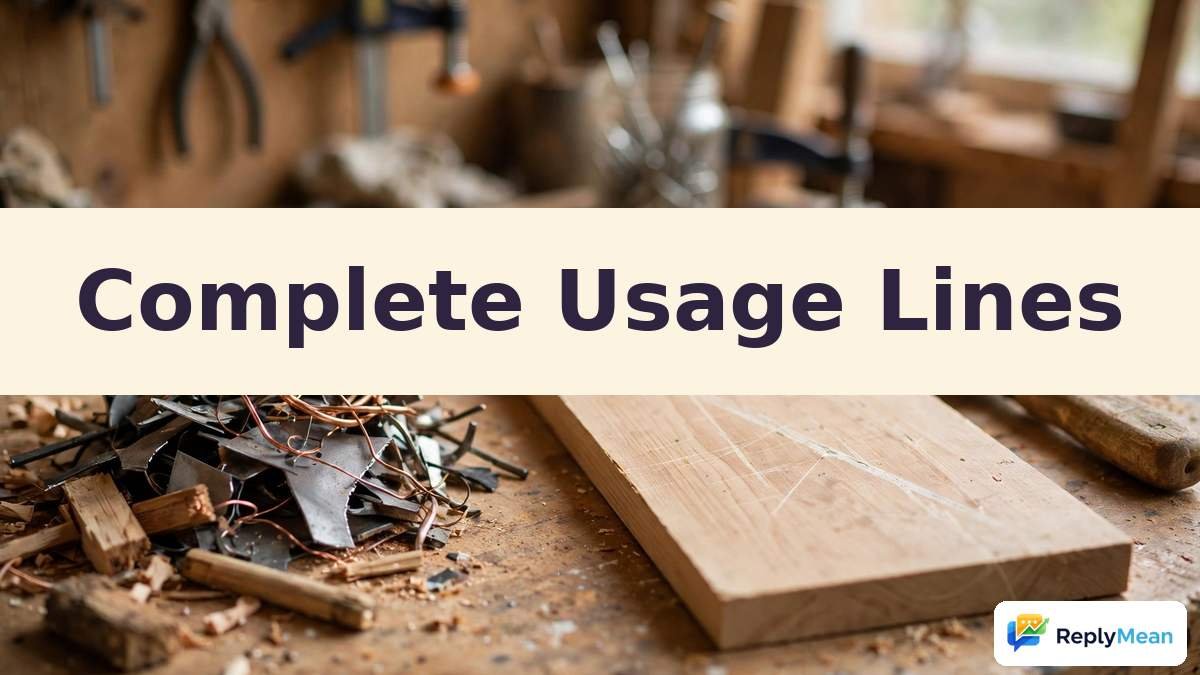
A bare word leaves the writer alone with the guess. Complete usage lines attach the two things a bare word omits — the scene it belongs to, and the object it holds. Ten scenes, ten lines:
- In an email cancelling a project: “We’re scrapping the spring launch and folding its budget into the autumn one.”
- On a workshop note: “Keep the copper offcuts by the door — that’s scrap, not rubbish.”
- In a text about a grazed knee: “Scraped my knee on the kerb. It’s a scrape, not a sprain.”
- In a recipe margin: “Scrape the bowl clean; the last spoonful is the best one.”
- In a report on evidence: “After three searches, the file held not a scrap of proof.”
- Texting about money: “We scraped together the deposit an hour before the deadline.”
- On a car-park note: “Sorry — I scraped your bumper at the gate. My number is below.”
- In a school essay: “The charity quilts are sewn entirely from scraps of donated fabric.”
- In the office kitchen: “Scrape the ice off the freezer shelf before Friday, please.”
- In a chat about exams: “She scraped through maths and sailed through history.”
When the Word Lands Wrong
The junkyard that became an injury.
A facilities manager emails the depot: “Mind the spare van — I scraped it this morning.” Two drivers spend the first hour walking the yard with a torch, hunting for body damage on a van that is not there.
The van had been scrapped at dawn — crushed, struck off the fleet list, gone. Scrape promises contact with something that survives; scrap promises an ending. The readers trusted the word over the world, so a disposed asset got inspected.
The repair names the fate, not just the act: “The spare van was scrapped this morning — it is off the fleet list.” A word plus its consequence leaves nobody searching a yard for a ghost.
The cancellation that sounded like a cleaning job.
A project lead posts in the team channel: “We’ll scrape the old portal on Friday.” Two developers nod, and spend Thursday polishing the portal’s interface — tidying pages, fixing labels — ahead of what they take to be a surface clean.
Scrape is a surface word: things survive being scraped, usually cleaner than before. Scrap is the ending word. The wrong verb did not just mislabel the task; it quietly rescheduled two days of work into a bin-bound product.
The repair gives endings the ending word, plus a date to act by: “We scrap the old portal on Friday — archive anything you need by Thursday.” The deadline does the work the verb could not.
The graze that read as litter.
A parent writes in the school note: “Tommy has a scrap on his knee from the playground.” The teacher checks the knee for something stuck to it — a plaster, a sticker, a bit of grit — before she checks it for a wound.
Scrap names a detached piece, so on a body it points the reader at debris. The injury word is scrape: a mark left on a surface, and skin is a surface. One letter sent the first aid in the wrong direction.
The repair is the surface word: “Tommy has a scrape on his knee.” Four words shorter than an explanation, and the reader is already reaching for the plaster box.
The fund that sounded cancelled.
A friend texts the group: “Great news — I scrapped together the holiday money!” The first reply lands in seconds: “Scrapped it? So no trip?” The celebration dies in a single word, and three people start unbooking things in their heads.
“Scrape together” is one of the dictionaries’ recorded phrases — to collect something by effort, bit by bit. Swapping in scrap flips collecting into cancelling, and a reader believes the flip because the sentence offers nothing else to believe.
The repair keeps money on the move with the effort word: scraped together, scraped up, scraped by. When the sentence is about gathering, the long word does the gathering.
Short Forms for Texts
Most swaps happen at text length, in the last line of a chat that is really about something else. These ten are built for that slot: one line each, the scene unmistakable, the spelling already settled:
- “Scrap that last message — wrong chat entirely.”
- “Scrap metal run on Saturday. Bring the trailer.”
- “Scraped the car. Tiny mark, huge mood.”
- “Not a scrap of battery left. Call me later.”
- “Scraped through! Results are in. I need a minute.”
- “Scrape the pan before whatever that is sets.”
- “One scrap of cake left. Dibs, obviously.”
- “We scraped by on two hours of sleep.”
- “Scrapped the plan, kept the snacks. Priorities.”
- “Mind the step — you’ll scrape your shins.”
Frequently Asked Questions
What is the difference between scrap vs scrape?
Scrap names a piece — material left over, a fragment, the least bit of anything — or throwing it away. Scrape names a rub — a mark, a graze, an effort — or barely managing. Hold the object, and the word follows.
Is it “scrap the plan” or “scrape the plan”?
Scrap the plan. The cancelling verb is scrap — dictionaries date that use to about 1891. Scrape the plan would mean rubbing the plan against something, which only works if it is written on a whiteboard.
Can scrap also mean a fight?
Yes — but it is a separate word that happens to share the spelling. Dictionaries list its origin as unknown and its first appearance in the 1840s: a scrap is a short fight or heated argument, as in “a scrap outside the ground”.
What does “scrape through” mean?
To succeed with nothing to spare: pass the exam, survive the week, qualify by one mark. The dictionaries phrase it as making your way with difficulty — the success is real, and so is the narrowness of the gap it came through.
Why do scrap and scrape get confused so often?
They differ by one letter and one vowel sound, they are the same length, and both work as nouns and verbs — so neither spelling, sound nor grammar can separate them. Only the scene can: piece or rub, ending or effort.
Is the stuff you scrape off called scrap?
Nearly — the rubbings-off are called scrapings. Scraps are the leftover pieces themselves, classically of food: the pan gives you scrapings when you scrape it; the table gives you scraps when you clear it.
Conclusion
Sorted by scene, the pair settles into two honest piles. Scrap keeps the pieces and the endings — the fragment, the metal, the cancelled plan. Scrape keeps the friction and the near-misses — the mark, the graze, the exam survived by a mark. And scrap vs scrape stops being a coin toss the moment the object is named.
For the formal name of what scraping does to a surface, the dictionaries reach for abrasion — a word built on the Latin abradere, “to scrape off”. So check the object, trust the scene, and let the spelling be the last true thing in the sentence.