25 Other Ways to Say Sorry for Your Loss (Gentle, Sincere & Warm)
People type what to say instead of sorry for your loss into a search box at one exact moment: the card is open, the phone is in hand, and the one sentence everyone says feels too small for the person in front of them.
Anyone hunting other ways to say sorry for your loss is really hunting for weight — words that carry some of the moment instead of just marking it. The twenty-five below are sorted by the offering test: what the phrase actually hands over.
Each entry carries a grade, one honest example and a plain note on where it helps — and where it would ring hollow: a formal line texted to a close friend, a light line sent to a grieving parent. Start with the shelf; the words follow.

Sorting the Twenty-Five by the Offering Test
Quick answer: other ways to say sorry for your loss sort by the offering test — what the phrase hands over. Witness lines face the pain, heart lines name your sorrow, stay lines promise presence, wish lines send peace ahead, and send lines travel by card or prayer.
Read in one pass, the twenty-five blur into one soft murmur of kindness. Read one at a time, they separate by what they hand over — and two of them arrive twice: the set of twenty-five carries twenty-three different sentences, with “My Heart Goes Out to You” and “I Can’t Imagine What You’re Going Through” each printed two times.
Five face the pain, five name your own sorrow, five promise to stay, five wish something ahead, and five travel to reach them. The grade under each entry names its shelf before anything else.
The Witness Shelf First, the Heart Shelf Second
Witness forms face the pain itself and refuse to decorate it: “I Can’t Imagine What You’re Going Through”, “I’m So Sorry You’re Going Through This”, “I Wish I Could Take Away Your Pain”, “I’m So Sorry for Your Heartache” and “I Can’t Imagine What You’re Going Through” again — the same sentence twice, graded twice.
Heart forms name the sender’s own sorrow instead: “My Heart Goes Out to You”, “My Deepest Sympathy”, “I’m Saddened to Hear About Your Loss”, “My Heart Goes Out to You” a second time and “My Heart Is Heavy for You”.
Ten forms, one shared rule: a witness line is only as good as its honesty, and a heart line is only as good as the relationship behind it. Spend both where they are true, and neither will ever sound like a formula.
The Stay Shelf Third, the Wish Shelf Fourth
Stay forms promise presence — at the door or in the mind: “You’re in My Thoughts”, “I’m Here for You”, “Thinking of You During This Difficult Time”, “I Am Here for You, Always” and “I’m Here to Listen Anytime”.
Wish forms send something ahead into the hard days: “Wishing You Peace and Comfort”, “May You Find Solace in Your Memories”, “Wishing You Strength and Courage”, “May Peace Find You Soon” and “I Wish You Peace and Comfort”.
The Send Shelf to Finish
Send forms travel — they are written, prayed or posted rather than said face to face: “Sending Love and Strength”, “You Have My Deepest Condolences”, “Sending You Love and Light”, “You Are in My Thoughts and Prayers” and “I’m Thinking of You and Your Family”.
These five carry the distances the other shelves cannot cross: the colleague in another city, the family you cannot visit, the friend whose door you should not knock on yet. Distance is their ground, and used at the doorstep they can sound like a letter read aloud.
The Check Every Offering Has to Pass
One discipline runs through every note here, borrowed from our guide to funny ways to say you want to smash. That guide sorts party lines by how much of the grin shows through the words; a condolence deserves the same audit, aimed at what it offers.
The audit is one question. What does this phrase actually hand over — a witness, a heart, a presence, a wish, or a parcel sent from far away — and is that the thing this mourner, today, most needs to receive?
“You Have My Deepest Condolences” is the classic mismatch: the most ceremonial sentence on the list, texted to a best friend at midnight, where its formality reads as distance from the one person who should sound closest.
Alternatives to “Sorry for Your Loss”
1. My Heart Goes Out to You
The reaching form: your heart pictured as travelling to where they are, because the rest of you cannot. It presumes a real bond — family, close friendship, a colleague whose life you actually know.
Its reach is its fence. Sent to a near-stranger, it claims a closeness that has not been earned, and the warmth arrives as performance. Grade: A− — heart-led, reaching ground.
- “I just heard about your dad. My heart goes out to you — all of you.”
- Best for: family, close friends and anyone whose grief you genuinely share
- Skip it: distant acquaintances, where the reach overclaims the bond
2. You’re in My Thoughts
The holding form: no promise, no advice, just the quiet fact that they are being kept in mind. It presumes distance — you cannot be there, and you are not pretending otherwise.
Its quietness is its fence. As the only sentence a close friend ever receives, it can read as a postcard sent instead of a visit. Grade: A− — stay-led, holding ground.
- “No need to reply to anything. You’re in my thoughts, today and in the weeks coming.”
- Best for: texts and cards across a distance, early and often
- Skip it: your closest people, when it replaces showing up
3. I’m Here for You
The doorway form: presence promised in four words — the offer of a person, not a sentiment. It presumes you mean the practical version: the call answered, the lift given, the kettle on.
Its promise is its fence. It is a debt the next month collects; said by someone who then disappears, it becomes the sentence mourners learn to discount. Grade: A — stay-led, doorway ground.
- “I’m here for you — for the paperwork, the house, the 2 a.m. wobbles. All of it.”
- Best for: anyone you will actually stay close to in the coming weeks
- Skip it: as a reflex, when you know you will not be around
4. My Deepest Sympathy
The dressed heart form: your sorrow named at full depth and in its formal clothes. It presumes a card, a letter or a work message — somewhere the register is written rather than spoken.
Its formality is its fence. In a late-night text to your oldest friend it wears a suit to a kitchen-table conversation, and the stiffness can read as distance. Grade: A− — heart-led, dressed ground.
- “Please accept my deepest sympathy. Your mother was a remarkable woman, and I was lucky to know her.”
- Best for: sympathy cards, work emails and letters to older relatives
- Skip it: close, informal friendships where you speak plainly
5. I Can’t Imagine What You’re Going Through
The honest-limit form: it admits the gap between your life and their loss instead of papering over it. It presumes the admission is true — you have not stood where they are standing.
Its honesty is its fence. Said by someone who buried a parent last spring, it stops being humility and becomes a false note the mourner can hear. Grade: A — witness-led, limit ground.
- “I can’t imagine what you’re going through. I won’t pretend to — I’m just here.”
- Best for: losses beyond your own experience, said early and simply
- Skip it: when you have lived the same loss and could honestly say so
6. Wishing You Peace and Comfort
The blessing form: it asks for nothing and promises nothing — it simply wishes them the two things grief takes away. It presumes a little distance in time or relationship: a card, a note with flowers.
Its gentleness is its fence. In the first raw days, peace can sound like a destination they are being hurried towards, and comfort like a word from someone dry-eyed. Grade: A− — wish-led, blessing ground.
- “Wishing you peace and comfort, and people around you who carry the practical things for a while.”
- Best for: cards, flower notes and messages a week or two in
- Skip it: the first forty-eight hours, when peace is not yet a kind word
7. Sending Love and Strength
The parcel form: two gifts packed and dispatched — love for the heart, strength for the road. It presumes you are sending from a distance, by text, card or group message.
Its cargo is its fence. Strength is a complicated gift; a mourner drowning quietly can hear it as an instruction to hold up better. Grade: B+ — send-led, parcel ground.
- “Sending love and strength to all of you — today, and on the ordinary hard days after.”
- Best for: group cards, texts from far away and team messages
- Skip it: as the only line to someone who is barely coping
8. Thinking of You During This Difficult Time
The full-sentence form: the holding thought of the stay shelf, written out in its complete, card-ready shape. It presumes a written message, where the longer sentence reads as care rather than padding.
Its wording is its fence. “This difficult time” is the phrase every card reaches for, so the sentence leans on the ones around it to prove it was written for this person. Grade: A− — stay-led, sentence ground.
- “Thinking of you during this difficult time — especially today, of all days. He was so proud of you.”
- Best for: sympathy cards and messages on the hard dates that follow
- Skip it: alone in a text, where its formality can cool the warmth
9. May You Find Solace in Your Memories
The memory form: it points past the funeral to the long companionship of remembering. It presumes a loss with good years behind it — a long marriage, a parent fully lived, a friendship with stories in it.
Its timing is its fence. Memories are not comfort to everyone yet; where the relationship was hard, or the death sudden, the suggestion can land as a door closed too early. Grade: B+ — wish-led, memory ground.
- “May you find solace in your memories of her — fifty years of them is a house no one can take away.”
- Best for: long lives, later weeks and anniversary messages
- Skip it: sudden losses and complicated relationships, early on
10. I’m So Sorry You’re Going Through This
The plain acknowledgment: sorrow and their situation, stated without decoration. It presumes nothing except that you have heard and you believe it is as bad as it is.
Its vagueness is its fence. “This” does a lot of unnamed work; where you can name the loss gently — a husband, a mother, a child — the named version carries more. Grade: A− — witness-led, plain ground.
- “I’m so sorry you’re going through this. Nobody should have to arrange a funeral for their brother.”
- Best for: first messages, voice notes and moments with no time to compose
- Skip it: in a card, where you had time to write the fuller sentence
11. I Wish I Could Take Away Your Pain
The impossible-wish form: it offers the one thing nobody can do, and the honesty of the wish is the comfort. It presumes closeness — the sentence borrows intimacy it has to be able to repay.
Its scale is its fence. To a colleague you barely know, the size of the claim can embarrass you both; it belongs to people whose pain you have actually watched. Grade: B+ — witness-led, impossible ground.
- “I wish I could take away your pain. Since I can’t, I’ll take the school run off your plate instead.”
- Best for: close family and friends, especially paired with a practical offer
- Skip it: professional relationships, where the claim outruns the bond
12. You Have My Deepest Condolences
The ceremonial form: condolence in its full official dress, the sentence organisations and formal letters are built from. It presumes a written channel and a relationship with some formality in it.
Its ceremony is its fence. Said aloud at a doorstep it can sound like a statement being read into a record, and the mourner may nod at the words instead of feeling them. Grade: A− — send-led, ceremonial ground.
- “You have my deepest condolences. On behalf of everyone at the practice, we were very sorry to hear of your loss.”
- Best for: workplaces, officials, clients and formal cards
- Skip it: face to face with people who know your ordinary voice
13. I’m Saddened to Hear About Your Loss
The news form: it reports your own reaction at the moment of hearing, which is often the truest thing available. It presumes you have just learned — the sentence is built for the first message.
Its distance is its fence. “About your loss” keeps the death itself at arm’s length, and a week later the hearing-frame has expired; the sentence dates quickly. Grade: B+ — heart-led, news ground.
- “I’m saddened to hear about your loss — Tom told me this morning, and I haven’t stopped thinking of you since.”
- Best for: the first reply, when the news has genuinely just reached you
- Skip it: later messages, where the frame belongs to the first day
14. Wishing You Strength and Courage
The road form: a wish aimed at the walk ahead rather than the day of the funeral. It presumes more hard things are coming — paperwork, probate, the first birthday — and says so kindly.
Its demand is its fence. Courage is something being asked of them; paired with no offer of help, the wish can feel like a spectator’s encouragement. Grade: B+ — wish-led, road ground.
- “Wishing you strength and courage for the weeks ahead — and reminding you that lifts to any appointment are mine to give.”
- Best for: cards sent ahead of hard milestones, and second messages
- Skip it: standing alone, with no practical offer travelling with it
15. I Am Here for You, Always
The long form of the doorway promise: the same four words with a duration bolted on. It presumes a bond measured in years — the friend, sibling or partner who will still be there in month six.
Its length is its fence. “Always” is the easiest word in the sentence to say and the hardest to keep; the grade rests entirely on the keeping. Grade: A− — stay-led, always ground.
- “I am here for you, always — not just this week. Month six, year two, the random Tuesdays. Always.”
- Best for: your closest people, when you intend to be measured by it
- Skip it: new relationships, where always has no track record yet
16. My Heart Goes Out to You
The reaching form a second time: the same sentence as the first entry, arriving again further down the list. It presumes exactly what it presumed before — a real bond — and offers the same warmth.
Its repetition is its fence. A set of twenty-five that carries it twice is counting generously; as a sentence it loses nothing, but as an entry it is the same door opened twice. Grade: B+ — heart-led, repeat ground.
- “However the week goes, my heart goes out to you. The offer of the spare room stands, too.”
- Best for: family and close friends, exactly like its first appearance
- Skip it: any list promising twenty-five different sentences
17. Sending You Love and Light
The gentle parcel: love, and light to see by — the softest cargo on the send shelf. It presumes a shared dialect; in some families and friendships the word light is the house language of comfort.
Its dialect is its fence. Outside that dialect it can float past as vagueness, and a family of deep faith may be waiting to hear their own words — prayer, God, heaven — named instead. Grade: B+ — send-led, light ground.
- “Sending you love and light across the miles. Her candle is lit in our window tonight, too.”
- Best for: gentle, spiritual-but-not-formal circles and faraway friends
- Skip it: mourners whose faith has specific words they need to hear
18. I’m Here to Listen Anytime
The listening form: presence with a specific offer attached — not help, not advice, just an ear with the door open. It presumes the mourner may need to tell the story more than once, to someone patient.
Its offer is its fence. “Anytime” includes 2 a.m. and the fourth telling of the same memory; if your patience has office hours, the sentence will find them. Grade: A — stay-led, listening ground.
- “I’m here to listen anytime — to the stories, the anger, the silence. No fixing, I promise.”
- Best for: talkers, storytellers and anyone grieving out loud
- Skip it: if you flinch at repetition, tears or long pauses
19. May Peace Find You Soon
The traveller form: peace pictured as something on its way to them, since they are in no state to go looking for it. It presumes a little time has passed, or a card that will arrive a little later.
Its “soon” is its fence. Grief keeps its own calendar, and to a mourner in week one the word can sound like a schedule being set for their healing. Grade: B+ — wish-led, traveller ground.
- “May peace find you soon, in small moments first — a morning that doesn’t hurt before your feet touch the floor.”
- Best for: cards a few weeks in, and thinking-of-you notes later
- Skip it: the first days, when soon is not a gentle word
20. I’m So Sorry for Your Heartache
The ache form: it names the pain by its oldest name and says sorry to the pain itself. It presumes a personal register — the sentence is built for one mourner, not a room.
Its word is its fence. Heartache is a smaller, softer word than death, and for the largest losses it can understate the fact it is trying to honour. Grade: B+ — witness-led, ache ground.
- “I’m so sorry for your heartache. He was the love of your life — there isn’t a tidy word for this, and I won’t reach for one.”
- Best for: widows, widowers and anyone whose loss is a love story
- Skip it: formal messages, where the register is too intimate
21. I Can’t Imagine What You’re Going Through
The honest-limit form a second time: the same admission as the fifth entry, word for word. It presumes the same truth — a loss outside your experience — and carries the same humility.
Its repetition is its fence. Graded once as the honest limit, it returns here as the list’s second echo; the sentence is as good as it was, the counting is what changed. Grade: B+ — witness-led, repeat ground.
- “I can’t imagine what you’re going through, and I won’t insult it by guessing. I’m on the train Saturday — the kettle’s my job.”
- Best for: losses beyond your experience, exactly like its first appearance
- Skip it: any list promising twenty-five different sentences
22. You Are in My Thoughts and Prayers
The faith form: thought and prayer named together, the second word doing the heavier lifting. It presumes the words are true on your side and welcome on theirs — a shared faith, or a known comfort in it.
Its reflex is its fence. Typed by habit to a mourner who does not believe, it can ring as a formula; typed by someone who does not pray, it rings as one too. Grade: A− — send-led, prayer ground.
- “You are in my thoughts and prayers — we prayed for you all by name at church on Sunday, and we’ll keep on.”
- Best for: families of faith, and mourners who have asked for prayer
- Skip it: as a reflex, where neither side of the sentence is true
23. My Heart Is Heavy for You
The weight form: your heart imagined as carrying a share of the load, and saying so. It presumes a poetic register between you — the sentence is written music, and needs a reader who hears it that way.
Its poetry is its fence. In a plain work card it can sound composed rather than felt, and some mourners want the flat words and the casserole instead. Grade: B+ — heart-led, weight ground.
- “My heart is heavy for you. She was the centre of every room she entered — of course the rooms feel wrong.”
- Best for: letters, eulogies’ margins and your most literary friendships
- Skip it: practical contexts, where help should lead and poetry follow
24. I Wish You Peace and Comfort
The blessing form a second time, with one joint changed: “wishing” becomes “I wish”, and the sentence stands a little more personally behind its wish. It presumes the same ground as its earlier twin — a card, some distance.
Its nearness is its fence. One small change separates it from the sixth entry, and as a line it works perfectly; as an entry it is the same blessing spoken by a slightly closer voice. Grade: B+ — wish-led, echo ground.
- “I wish you peace and comfort — and I’m close enough to help chase both. The freezer is full whenever you’re ready.”
- Best for: cards and notes from nearer friends than the sixth entry serves
- Skip it: any list promising twenty-five different blessings
25. I’m Thinking of You and Your Family
The wide form: the circle of sympathy widened past the one mourner to the whole grieving house. It presumes a family loss — a parent, a spouse — where several people are carrying the same week.
Its width is its fence. For a private grief — a miscarriage unmentioned, a loss the family has not gathered around — the wide address can overreach what you were told. Grade: A− — send-led, family ground.
- “I’m thinking of you and your family — all of you. Your dad held that whole street together, and we feel it too.”
- Best for: family bereavements, neighbours and whole-household losses
- Skip it: private losses you only know of in confidence
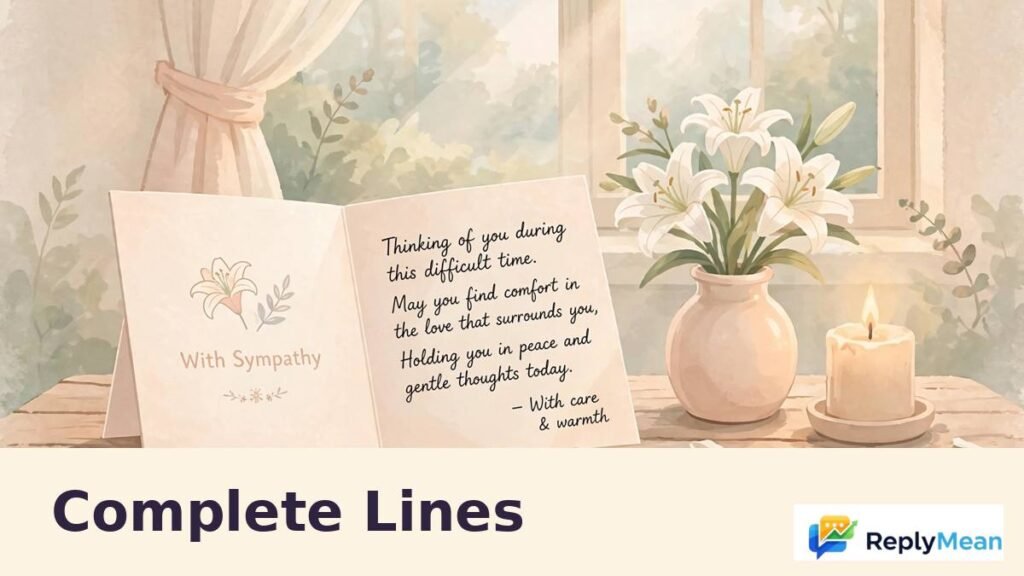
Complete Lines: The Sentence in a Finished Message
A phrase still needs its message around it before it can be sent. The ten lines here are finished — shelf, setting and second sentence in one — ready for the card, the text and the note that goes with the flowers.
- For the card, to a close friend: “I was so sad to hear about your mum. My heart goes out to you — I’m here, for the funeral and for the ordinary Tuesdays after.”
- For the text, on the first day: “Just heard. I’m here for you — no need to reply to this. I’ll check in again tomorrow.”
- For the work email, to a colleague: “Please accept my deepest sympathy. Take whatever time you need; your work is covered, and we are all thinking of you.”
- For the flowers, on the small card: “Wishing you peace and comfort. With love from all of us at number 12.”
- For the doorstep, in person: “I can’t imagine what you’re going through. I’ve brought dinner — it’s in the bag, and I’m not staying unless you want company.”
- For the old friend, far away: “You are in my thoughts and prayers every day. When you’re ready to talk about him, I want to listen.”
- For the second week, when others fade: “Still thinking of you and your family. No reply needed — I just didn’t want the quiet to feel like forgetting.”
- For the neighbour, across the fence: “My heart is heavy for you. If the garden, the bins or anything at all needs doing, knock on my door.”
- For the team, on the group message: “Sending love and strength from everyone here. We’ll be at the service, and the kettle offer stands for as long as it helps.”
- For the anniversary, a year on: “A year on, and I still think of her whenever the choir sings. May you find solace in your memories today.”
When the Words Land Wrong
A kind phrase rarely fails while you write it — it fails in the reading, when the register, the timing or the claim does not match the room it lands in. Four repairs follow, each one a move from the wrong shelf to the right one.
“You Have My Deepest Condolences” Texted to Your Closest Friend
A best friend loses a parent at midnight, and the reply that goes back is the most ceremonial sentence on the list. The formality that serves a work card reads, at that hour, as a wall going up.
The repair steps down from send to stay. “I’m here for you — getting in the car now” carries the same love at the right distance: a person arriving, not a statement being issued.
“I Can’t Imagine What You’re Going Through” — From Someone Who Can
A woman who buried her own mother in March hears of a friend’s loss in June and sends the honest-limit line out of habit. The mourner knows her history, and the sentence arrives as a small untruth.
The repair keeps the witness and drops the limit. “I know some of this road, and I’m so sorry you’re on it” witnesses honestly — and the shared ground becomes the comfort instead of the obstacle.
“May Peace Find You Soon” in the First Two Days
A card written on the day of the funeral wishes the widow peace, soon. She reads it at the kitchen table that night, where soon feels like an instruction and peace like a country she cannot imagine.
The repair steps back from wish to witness. “I’m so sorry for your heartache — today is just today, and I’m here for it” asks nothing of the future and stays in the room she is actually in.
“Sending You Love and Light” to a Family of Deep Faith
A colleague sends the gentle parcel to a family whose whole life is prayed, and the word light floats past them. They were listening for their own language, and the message never quite arrives.
The repair stays on the send shelf and names the faith. “You are in my thoughts and prayers” speaks the family’s dialect exactly — the same distance crossed, in words that land.

Short Forms for Cards & Texts
Most condolences are not speeches; they are a line on a small card, a text sent from a parked car, a note tucked into flowers. The short forms keep the offering and drop the ceremony — small enough for a card, warm enough to be kept.
- “Thinking of you 🤍” — the stay form, shortened: for a text on any of the hard days.
- “Here for you — always.” — the stay promise, shortened: for the friend you will actually show up for.
- “My heart goes out to you.” — the heart form, kept whole: small enough for a card’s last line.
- “With deepest sympathy.” — the formal form, shortened: for cards, flowers and work messages.
- “So sorry for your heartache.” — the witness form, shortened: the ache named in five words.
- “Wishing you peace.” — the wish form, shortened: for the note that travels with flowers.
- “Here to listen, anytime.” — the listening form, shortened: an offer with its door left open.
- “In my thoughts and prayers.” — the prayer form, shortened: where faith is shared on both sides.
- “Sending love and strength.” — the parcel form, kept whole: for the group card everyone signs.
- “Thinking of you all.” — the family form, shortened: when the whole house is grieving.
Frequently Asked Questions
Is it wrong to just say “sorry for your loss”?
No. It is plain, kind and understood everywhere, and no grieving person has marked a card down for using it. Its only weakness is wear: said by everyone, it can sound automatic. One specific sentence — a memory, an offer — restores the weight.
What is the single best thing to say when someone dies?
Presence, witnessed honestly: a stay line you will keep, paired with a witness line that does not pretend. “I can’t imagine what you’re going through, and I’m here” outperforms every polished formula, because both halves are true and both halves stay.
Why do two phrases appear twice in this list?
Because the list of twenty-five carries them twice. “My Heart Goes Out to You” stands first and sixteenth, and “I Can’t Imagine What You’re Going Through” fifth and twenty-first — twenty-three different sentences in twenty-five places, each repeat graded as a repeat.
What should I write in a sympathy card?
A formal opener, one specific line, and a door left open. “My deepest sympathy” to open, one true sentence about the person who died, and “I’m here for you” to close — three sentences beat a page of borrowed verse.
Is it alright to offer prayers?
Yes, where they are welcome: a family of faith often finds the prayer form the warmest on the list. Where you are unsure of their ground, the thought forms carry the same care without presuming — and a prayer actually prayed needs no one’s permission.
Conclusion:
The twenty-five are one sentence wearing twenty-five weights. Sort other ways to say sorry for your loss by the offering test — witness, heart, stay, wish or send — and the words stop being a formula and become a choice you made for this person, this week.
Underneath every shelf sits the same small truth: the phrase matters less than the staying power behind it. The dictionary gives condolence a plain definition — sympathy for someone who is suffering — and the lines worth sending are simply that sympathy, kept.